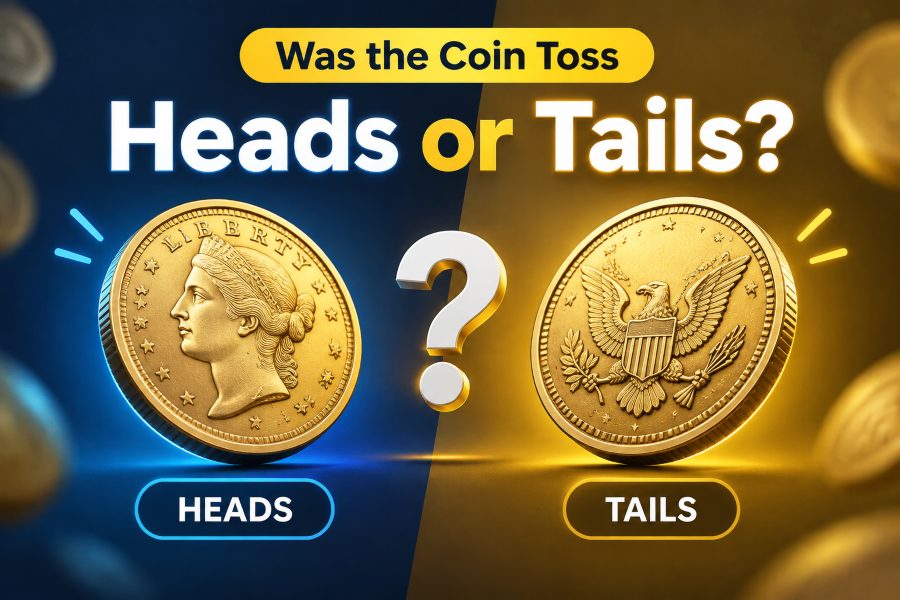
It is the universal tie-breaker. It is the decider of fates, the arbiter of arguments, and the final word in everything from who gets the last slice of pizza to who kicks off the Super Bowl. Since the dawn of civilization, humans have turned to a small disc of metal to answer the question: “Who goes first?”
But as we stand in the moment of truth—the coin spinning in the air, a blur of silver against the sky—we rarely stop to ask the deeper questions. We assume the outcome is pure chance, a 50/50 split ordained by the gods of probability. Yet, the question “Was the coin toss heads or tails?” is far more complex than a simple binary answer.
The reality is that a coin toss is not a perfect random number generator. It is a chaotic physical event governed by Newtonian physics, influenced by human biomechanics, and interpreted through the lens of cognitive psychology. And sometimes, the outcome has nothing to do with luck at all.
Let’s dive deep into the anatomy of the coin toss to understand the physics, the history, and the strange psychological power of the flip.
The Physics of the Flip: Why It Isn’t 50/50
If you ask the average person on the street what the odds of a coin landing on heads are, they will tell you “50 percent.” This is the foundational assumption of the coin toss. However, if you ask a physicist, they will tell you that the outcome is determined the moment the coin leaves your thumb.
A coin toss is not magic; it is a physics problem. When you flick your thumb, you impart a specific amount of force (Newtons) and torque (rotational force) to the coin. Gravity pulls it down, air resistance slows its spin, and the angle of your hand determines the initial trajectory. In theory, if you could measure all these variables—the exact force of the flick, the mass of the coin, the air density, and the height of the toss—you could calculate with 100% certainty whether the coin will land heads or tails before it even reaches its apex.
This concept is known as determinism. It suggests that the universe is a chain of cause and effect, and “randomness” is simply a lack of information. If you had a supercomputer capable of processing the flight path, the coin toss would cease to be a gamble and become a math equation.
The “Same Side” Phenomenon
In 2007, a group of researchers at Stanford University, led by mathematician Persi Diaconis, conducted a rigorous study on the physics of coin tossing. Their findings shattered the myth of the perfect 50/50 split.
Diaconis and his team built a mechanical coin flipper to eliminate human error and filmed the tosses with high-speed cameras. They discovered that a coin tossed and caught in the hand is not random. Because of the wobble and precession (the way the coin wobbles like a top as it spins), the coin has a tendency to land on the same side it started.
Specifically, they found that a coin has about a 51% chance of landing on the side that was facing up before the flip.
Why? It comes down to the physics of the wobble. The coin is not a perfect cylinder; it has raised reliefs (the heads and tails images), and the weight distribution is slightly off-center. This imperfection causes the coin to spend slightly more time in the air with the “heavy” side down. If the coin starts heads up, the physics of the wobble favor it landing heads up again.
The study concluded that while 51% isn’t a massive advantage, it is statistically significant. So, the next time you are asked, “Was the coin toss heads or tails?” remember that the answer was likely determined before the coin even left your hand—and it was probably the side that was already showing.
The Extreme Sensitivity of Initial Conditions
There is a reason we perceive the coin toss as random, though. It is because of a concept popularized by chaos theory: the Butterfly Effect.
Even the slightest variation in the initial conditions of the toss leads to a completely different outcome. If you change the force of your thumb flick by 0.001%, the coin might land tails instead of heads. Because human muscles are incapable of delivering the exact same force twice in a row, we cannot control the outcome. We are physically incapable of being deterministic, so we rely on probability.
But what if the coin doesn’t spin? What if it just flips? In 1993, statistician Joe Keller argued that if a coin is flipped in a way that it rotates perfectly around a horizontal axis (like a tiddlywink), it acts like a flywheel and will land on the same side it started. However, in a standard toss, the coin spins around a vertical axis as well. It is this combination of spins—wobble and rotation—that creates the illusion of randomness.
The History of the Flip: From Lydia to the NFL
The question “Was the coin toss heads or tails?” has been asked for a very long time. The practice of flipping a coin to make a decision dates back to ancient times.
The earliest coins, minted in the Kingdom of Lydia (modern-day Turkey) around 600 BC, were made of electrum. These coins often featured a lion’s head on one side and a bull’s head on the other. While we don’t have records of ancient Lydians flipping them to decide who bought the beer, the concept of using metal discs for divination was common.
The Romans popularized the practice. They called it navia aut caput (ship or head), referring to the images on the Roman denarius. Soldiers would flip the coin to settle disputes or decide fates.
The Super Bowl Tradition
In the modern era, the coin toss has become a cultural icon, largely due to American football. The tradition began in the NFL in 1947. Originally, the referee would toss the coin, but in 1976, the NFL introduced the “coin toss captain”—a ceremonial position usually given to a celebrity or a former player.
The coin toss is so ingrained in our culture that it has become a superstition. Fans believe that winning the toss is a good omen. However, statistically, the coin toss has almost no bearing on the outcome of the game. Yet, the ritual persists because it adds a layer of theater to the sport.
Interestingly, the NFL uses a special “Heads” coin and a “Tails” coin for the playoffs. The coin is usually a commemorative piece, often gold-plated. But even these heavy, ornate coins follow the laws of physics. They wobble, they spin, and they are subject to the 51% bias discovered by Diaconis.
The Psychology of the Toss: Why We Ask the Question
If a coin toss is just a physics event, why do we care so much? Why do we ask, “Was the coin toss heads or tails?” with such bated breath?
The answer lies in psychology. Humans are pattern-seeking creatures. We hate ambiguity. We crave resolution. The coin toss provides a definitive, external answer to a question we cannot answer ourselves.
Decision Fatigue and Cognitive Load
Psychologists have found that making decisions depletes our cognitive resources. This is known as decision fatigue. When we are tired or overwhelmed, we look for shortcuts. The coin toss is the ultimate shortcut.
By outsourcing the decision to a coin, we remove the burden of responsibility. If the coin says “Heads,” we go to the Italian restaurant. If it says “Tails,” we go for sushi. We didn’t choose the restaurant; the coin did. This relieves the anxiety of making the “wrong” choice.
However, there is a catch. If you feel a sense of relief or disappointment when the coin lands, you actually knew what you wanted all along.
The “Coin Toss” as a Revealer of Preference
There is a famous psychological test often attributed to Sigmund Freud, though it is more folklore than clinical practice. It goes like this:
A man is unsure whether to marry his girlfriend. He decides to flip a coin. If it lands heads, he will propose. If it lands tails, he will break up with her.
The coin is flipped. It lands heads.
The man feels a sudden pang of disappointment. He realizes he was hoping for tails.
In this scenario, the coin toss didn’t decide the man’s fate; it revealed his true feelings. The 50/50 chance forced him to confront the outcome he feared or desired.
This is why the coin toss is so effective as a decision-making tool. We often ask, “Was the coin toss heads or tails?” not because we care about the physics, but because we care about our reaction to the result. The coin toss is a mirror.
Loss Aversion and the Illusion of Control
Behavioral economists note that humans are loss-averse. We feel the pain of a loss twice as much as the pleasure of a gain. When we flip a coin, we often experience a “near miss” sensation. If you call heads and it lands tails, you feel like you almost won.
This is known as the Near Miss Effect. It is the same psychological mechanism that keeps people playing slot machines. It creates engagement and suspense. The coin toss is a micro-dose of gambling, which releases dopamine in the brain.
Furthermore, we suffer from the Illusion of Control. We believe we can influence the outcome of the toss. This is why you see people blowing on the coin before they flip it, or “calling” the coin aggressively. In reality, the coin doesn’t care. But the ritual gives us a sense of agency in an indifferent universe.
The Mathematics of the Toss: Probability and Statistics
Let’s get back to the numbers. We know the physical toss has a bias. But what about the coin itself?
In statistics, the coin toss is the standard example of a Bernoulli Trial—a random experiment with exactly two possible outcomes: success or failure. The probability of getting heads in a fair coin toss is denoted as P(H)=0.5.
However, the real world is messy. As mentioned, the Stanford study showed a bias. But there is another factor: the coin itself.
Are Coins Actually Fair?
In 2009, a group of students at the University of British Columbia conducted an experiment. They flipped coins not by tossing them in the air, but by spinning them on a table. They found that spinning coins land tails up more often than heads—about 80% of the time.
Why? Because the “heads” side of a coin is usually heavier (due to the relief of the face), causing the center of mass to shift. When the coin spins on its edge, the heavier side (heads) wants to be closer to the table (the ground). This is like a weighted roulette wheel.
However, when a coin is flipped in the air, the physics change. The wobble effect (precession) takes over, leading to the 51% “same side” bias mentioned earlier.
The Law of Large Numbers
The Law of Large Numbers states that if you flip a coin 1,000 times, the results will approach a 50/50 split. If you flip it 10 times, you might get 7 heads and 3 tails. This is variance.
If you ask, “Was the coin toss heads or tails?” in a single instance, the result is unpredictable. But over a lifetime of tosses, the universe balances out.
This is why the coin toss is used in legal settings. In 1845, a man named John Davis was accused of murder in the United States. The jury was deadlocked. The judge, in a moment of bizarre creativity, ordered the jury to flip a coin to decide the verdict. The coin landed heads, and Davis was acquitted. (Note: This is a historical anecdote, and such a practice would be illegal today, but it illustrates the finality we assign to the coin).
The Philosophy of the Toss: Free Will vs. Determinism
The question “Was the coin toss heads or tails?” leads us to the deepest philosophical debate of all: Do we have free will?
If the universe is deterministic, the coin toss was decided at the Big Bang. The atoms were arranged in such a way that your thumb would flick with a specific force, the air resistance would be a specific value, and the coin would land on heads. You had no choice.
If the universe is probabilistic (quantum mechanics), then the coin toss is truly random. The outcome is not determined until the coin hits the ground (or is observed).
The coin toss is a perfect metaphor for the human condition. We live in a world that feels random, but we try to impose order on it. We create rules, games, and rituals to make sense of the chaos.
When we ask, “Was the coin toss heads or tails?” we are really asking, “Is the universe on my side?”
Cultural Variations: Tails Never Fails?
Different cultures have different relationships with the coin toss.
- “Heads I win, Tails you lose”: This is a common phrase in English, implying a zero-sum game.
- “Tails never fails”: A popular chant in sports, particularly in the UK and US, reflecting the underdog status of tails.
- “Cross or Pile”: In Britain, the tails side of a coin historically featured a cross, leading to the phrase “cross or pile” (pile referring to the pile of metal or the ship on the other side).
In some cultures, the coin toss is used for divination. The I Ching, the ancient Chinese Book of Changes, uses a ritual of tossing three coins six times to generate a hexagram. In this context, the coin toss is not a game; it is a sacred communication with the cosmos.
Conclusion: It Doesn’t Matter (But It Does)
So, was the coin toss heads or tails?
Scientifically, the answer is determined by the physics of the wobble. It is likely to be the side that started up, a 51% probability in a fair toss.
Psychologically, the answer is a reflection of your desires. If you are disappointed, you know what you wanted.
Philosophically, the answer is a reminder that we are at the mercy of forces greater than ourselves—whether that is gravity, probability, or fate.
The coin toss is a beautiful, simple act that encapsulates the human experience. It is a game of inches, a leap of faith, and a surrender to the unknown. We flip the coin because we cannot know the future. We ask “Heads or Tails?” because we are desperate for an answer.
And in the end, the coin doesn’t care. It spins, it wobbles, and it lands. We are left to live with the result. So, the next time you hold a coin in your hand, ready to decide the fate of your afternoon or your career, remember: the coin is not just a piece of metal. It is a tiny, spinning universe of possibility. Call it in the air.