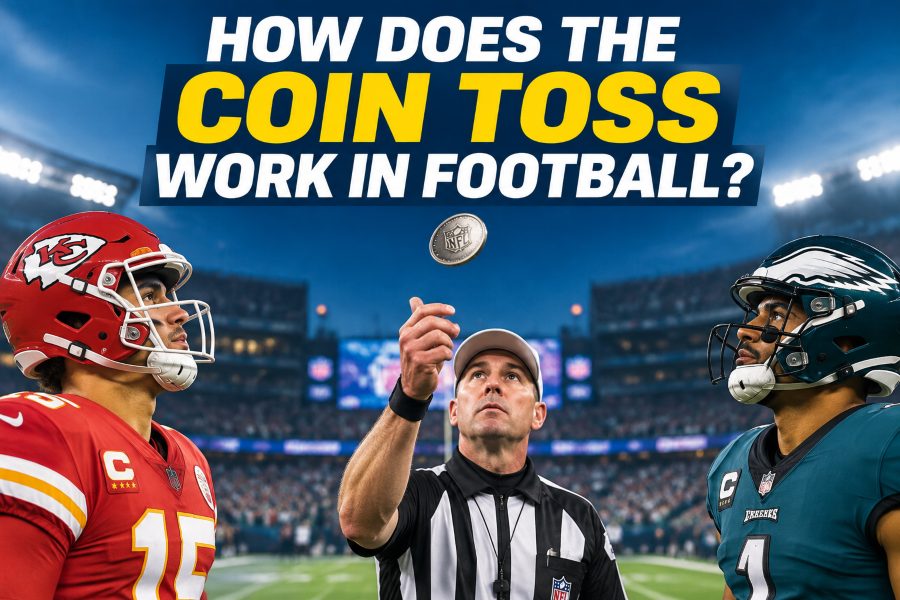
The coin toss is one of the most iconic—and least understood—rituals in football. It lasts just a few seconds, yet it sets the tactical foundation for the entire match, determines who kicks first in a penalty shootout, and, in rare historical cases, has even decided the outcome of major tournaments. For a procedure so deeply embedded in the fabric of the game, most fans know surprisingly little about the precise rules, the psychology behind it, and the ongoing debates about its fairness. This article explores exactly how the coin toss works in football, from the kick-off to extra time to the drama of a penalty shootout.
The Basics: What the Coin Toss Actually Decides
At its core, the coin toss is a mechanism for resolving two fundamental questions before a match begins: which team will take the kick-off, and which goal each team will attack in the first half. The procedure is governed by Law 8 of the Laws of the Game, which states: “the referee tosses a coin and the team that wins the toss decides which goal to attack in the first half or to take the kick-off”. Crucially, the winner does not automatically get the kick-off. They get to choose between two options: either selecting which end to attack, or choosing to take the kick-off. The loser receives whatever is left.
This distinction matters more than it might appear. A team that chooses to attack a particular goal in the first half is effectively deciding that they will defend the opposite goal, meaning they will switch ends at half-time and attack the other direction in the second half. If they instead choose to take the kick-off, they surrender the choice of ends to their opponents, but they gain the psychological and tactical benefit of starting the match with the ball.
There is also a matter of etiquette. Convention dictates that the visiting team’s captain makes the call of “heads” or “tails” before the referee flips the coin. This is a gesture of politeness and sportsmanship, though the referee retains the authority to determine which side of the coin represents which team if no call is made.
The Kick-Off Coin Toss: Setting the Stage
Before the referee blows the whistle to start the match, the two captains meet at the centre circle. The referee, holding the coin, designates one side as “heads” and the other as “tails” (or allows the visiting captain to call it). The coin is flipped, and the winner makes their choice. The most common outcome is that the winning captain chooses which goal to attack, leaving the kick-off to the opposing team. This has a practical logic: starting the match with the ball is often seen as less valuable than ensuring that your team is facing the direction it prefers, whether due to sun glare, wind conditions, or the psychological comfort of attacking a particular end in front of your own supporters.
However, some captains prefer to take the kick-off, especially if they believe that early possession can help their team settle into the game. The team that loses the toss simply takes whatever is left: they either kick off or defend the remaining goal. At the start of the second half, the teams change ends and attack the opposite goals. The team that decided which goal to attack in the first half takes the kick-off to start the second half. This means that the coin toss has a direct, symmetrical consequence for both halves of the match.
The Coin Toss in Extra Time
If a match requires extra time—two periods of fifteen minutes each—the coin toss procedure is repeated. Law 8 specifies that the referee tosses a coin before the start of extra time because it constitutes a new “kick-off”. The same rules apply: the winner chooses between attacking a specific goal or taking the kick-off, and the loser receives the alternative. This gives the captain who wins the toss a second opportunity to influence the flow of the game, potentially exploiting fatigue, momentum, or environmental factors that have emerged during normal time.
The Penalty Shootout: Two Tosses, Two Decisions
The coin toss becomes significantly more consequential—and more complex—when a match goes to a penalty shootout. Under the current Laws of the Game, the referee is required to conduct two separate coin tosses before the first kick is taken.
The first toss determines the goal at which all the kicks will be taken. Unless there are overriding considerations such as ground conditions or safety, the referee tosses the coin to decide which end will host the shootout. This choice may only be changed for safety reasons or if the goal or playing surface becomes unusable. The second toss then determines which team takes the first kick. The winner of this second toss decides whether their team will shoot first or second, and the opposing team takes the remaining option.
This two-toss system has been a source of debate for years. In 2026, FIFA proposed a change that would have reduced the procedure to a single coin toss, with the winning team choosing either to shoot first, shoot second, or select which goal to use, while the losing team would receive the remaining option. The proposal was intended to streamline the process and reduce the number of ceremonial pauses before the high-pressure shootout. However, the International Football Association Board (IFAB), football’s rule-making body, rejected the change, meaning the two-toss system remains in place for the foreseeable future.
Why the Toss Matters: Strategy and Psychology
The coin toss is not merely a ceremonial formality. Research has consistently shown that winning the toss in a penalty shootout confers a significant advantage. A landmark study covering major competitions between 1970 and 2003 found that the team taking the first penalty won 60.5% of the time. Later research, conducted after the 2003 rule change that allowed the toss winner to choose between going first or second, revealed that about 60% of teams that won the toss went on to win the shootout, compared with a win rate of 51% for teams that simply shot first.
The psychological explanation is straightforward: the team that shoots second is always playing catch-up. If the first team scores, the second team faces immediate pressure to equalise. If the first team misses, the second team has an opportunity to seize the advantage—but that opportunity comes with its own burden of expectation. This “lagging behind” effect creates a measurable performance deficit, which is why the toss winner almost invariably elects to shoot first.
There is also a tactical dimension to the first toss—the one that decides which goal is used. Goalkeepers may have a preferred end based on the condition of the penalty area, the background behind the goal (which can affect visibility), or the proximity of their own supporters. A captain who wins the first toss can choose the end that best suits their goalkeeper, potentially gaining a marginal but meaningful advantage.
Historical Context and Notable Incidents
The coin toss has a history that stretches back far beyond the codification of football. Historians trace the practice to ancient Rome, where it was known as “heads or ships”—one side of the coin bore the emperor’s head, the other a ship. The tradition was adopted into modern sport as a simple, impartial way to resolve disputes, and it became embedded in football’s laws from the earliest days of the Football Association.
In the pre-modern era, the coin toss was sometimes used to decide far more than kick-off direction. Before penalty shootouts became standard, drawn cup ties were occasionally settled by the flip of a coin. The most famous example came in the semi-finals of the 1968 European Championship, when Italy and the Soviet Union could not be separated after extra time. The referee tossed a coin, and Italy’s captain, Giacinto Facchetti, called tails. The coin landed in Italy’s favour, sending them to the final, which they eventually won. Facchetti’s call became one of the most celebrated coin tosses in football history—a moment of pure chance that decided a major tournament semi-final.
A similar incident occurred in the 1964–65 European Cup quarter-finals, when Liverpool and Cologne played three matches without a winner. The tie was finally decided by a coin toss, with Liverpool captain Ron Yeats calling correctly. These episodes serve as reminders that the coin toss was once a mechanism for deciding matches outright, not merely for determining kick-off direction.
Recent Debates and Proposed Changes
The coin toss continues to evolve. As mentioned, FIFA’s 2026 proposal to reduce the penalty shootout procedure to a single toss was rejected by IFAB. The debate reflects a broader tension between tradition and efficiency. Proponents of the single-toss system argued that it would simplify the process and reduce the time between the end of extra time and the first penalty kick—a period that is often filled with tension and ceremony. Opponents argued that the two-toss system preserves the purity of the procedure, ensuring that the two decisions (which goal and who kicks first) are made independently and without strategic coupling.
There have also been suggestions that the coin toss itself should be replaced by a more skill-based mechanism, such as a “shootout” from the halfway line or a set of predetermined criteria based on group-stage performance. However, these proposals have gained little traction. The coin toss remains deeply entrenched in the culture of the game, valued for its simplicity, its impartiality, and its capacity to generate moments of drama and controversy.
Conclusion
The coin toss may last only a few seconds, but its impact can be felt for ninety minutes and beyond. It determines who starts with the ball, which end each team attacks, and—crucially—who takes the first penalty in a shootout. The rules are precise, the psychology is subtle, and the history is rich with moments where a single flip of a coin changed the course of footballing history.
For players and coaches, the coin toss is a reminder that some aspects of the game remain beyond their control. For fans, it is a moment of anticipation—a brief, ceremonial pause before the chaos of the match begins. And for the sport itself, it is a tradition that connects the modern game to its ancient roots, a simple ritual that continues to shape the beautiful game in ways both large and small. Whether it is the kick-off of a World Cup final or the start of a penalty shootout in a local league, the coin toss remains one of football’s most enduring and consequential traditions.