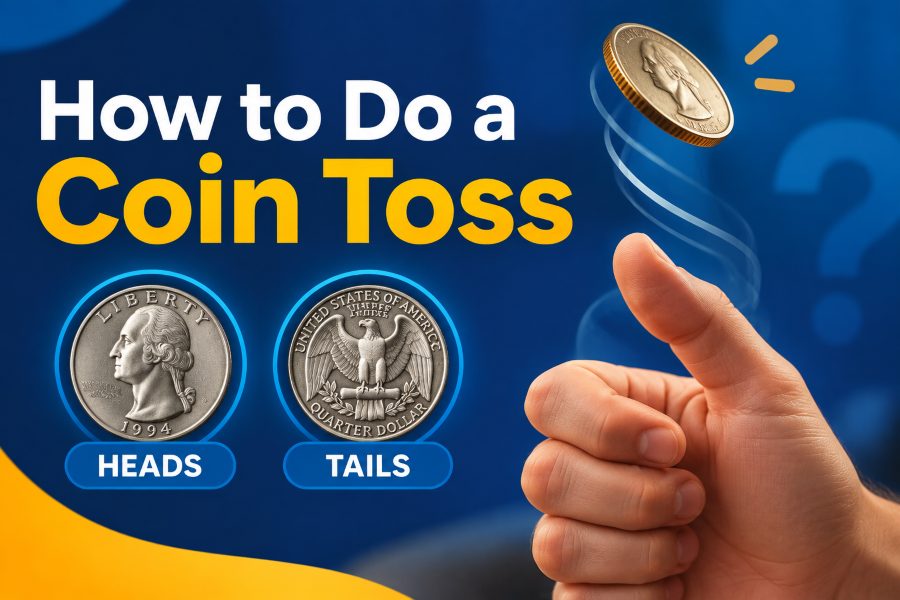
We have all been there. You are standing at a crossroads, paralyzed by indecision. Should you order the pasta or the steak? Should you take the job in the city or stay in the suburbs? Should you text them back or play it cool?
In a world obsessed with data, pros-and-con lists, and endless deliberation, there is one tool that remains timeless, simple, and universally understood: the coin toss. It is the great equalizer, a 50/50 shot that hands over your fate to the laws of physics and probability.
But is a coin toss really just a game of chance? Or is there an art to it? Whether you are looking to settle a friendly bet, make a life-changing decision, or simply learn a cool party trick, understanding the mechanics and the philosophy of the coin toss is an essential life skill.
In this guide, we are going to dive deep into the world of the flip. We will cover the history, the step-by-step technique for the perfect toss, the science behind why it works, and even how to use it as a psychological tool for decision-making. Let’s get started.
The Ancient History of the Flip
Before we get into the “how,” let’s look at the “why.” The coin toss is not a modern invention. It is an ancient practice that predates the vending machine, the stock market, and even the written word in some cultures.
The concept of sortition—selecting individuals for roles or making decisions by lottery—has been around for millennia. In Ancient Greece, the Athenians used a device called the kleroterion to randomly select citizens for jury duty and political office. They believed that random selection was the purest form of democracy, preventing corruption and factionalism.
The coin toss as we know it, however, gained significant popularity in the Roman Empire. Romans used a coin called the denarius to settle disputes. The phrase “Heads or Tails” actually has roots in the imagery found on these ancient coins. In Roman times, one side often depicted the head of a deity or emperor (Heads), while the other side depicted a ship’s prow or a specific symbol (Tails).
Interestingly, the idiom “to decide by a flip of a coin” entered the English lexicon in the 18th century, largely due to the popularity of cricket. The coin toss became the standard method for captains to decide who bats first, a tradition that continues in sports like cricket, football, and tennis to this day.
So, when you flip a coin, you are participating in a tradition that is thousands of years old, connecting you to Roman soldiers and Athenian citizens alike.
The Anatomy of a Coin Toss: Step-by-Step
Now, let’s get practical. You might think, “I know how to flip a coin, you just flick your thumb.” But to ensure a fair, high-arching, and satisfying toss, technique matters. A weak toss can lead to a “flop,” where the coin lands flat without spinning, which doesn’t provide the randomization we need.
Here is the definitive guide on how to perform a proper coin toss.
Step 1: Choose the Right Coin
Not all coins are created equal. For the best experience, you want a coin with a bit of weight and a distinct edge.
- The Quarter: This is the gold standard for coin tosses in the US. It is heavy enough to get good air, large enough to see, and has a distinct ridge.
- The Nickel: A close second, slightly heavier than a quarter, which makes for a satisfying “clink” when it lands.
- The Penny: Generally too light. It tends to flutter and is easily influenced by air resistance.
- The Euro: The 1 Euro coin is excellent due to its bi-metallic design and weight.
- The “Challenge” Coin: If you are serious about decision-making, some people use a “Challenge Coin” (often used in the military). These are heavy and often have sentimental value.
Pro Tip: Avoid using a coin that is sticky or covered in pocket lint. A clean coin spins better.
Step 2: The Grip (The Thumb Flick)
There are two primary ways to hold the coin. The “Thumb Flick” is the most common and the standard for fair tosses.
- Placement: Rest the coin on the knuckle of your index finger (the proximal phalanx). Do not place it in the palm; the palm creates too much friction.
- The Thumb: Place the tip of your thumb firmly under the edge of the coin, near the center. The nail of your thumb should be pointing toward the ceiling.
- The Index Finger: Your index finger should be curled slightly, supporting the coin from underneath, or pointing straight out as a guide.
- The Snap: The power comes from the thumb. You want to snap the thumb upward, pushing the coin off the knuckle. It should feel like a spring releasing.
Step 3: The Toss (Height and Spin)
The goal here is to achieve vertical rotation and sufficient air time.
- The Motion: Keep your hand relatively still. The motion should be an upward snap of the thumb, not a swing of the arm. If you swing your arm, you introduce the possibility of catching it or creating a weird arc.
- Height: Aim for chest or eye-level height. A toss that is too high (above your head) increases the chance of the coin hitting the ceiling or drifting away due to air currents. A toss that is too low doesn’t allow for enough rotations to ensure randomness.
- Spin: You want the coin to spin rapidly. A rapidly spinning coin is a fair coin. If the coin flips end-over-end only once or twice, the toss is technically biased toward the side that started up.
Step 4: The Catch (Or the Landing)
There are two schools of thought here:
- The Clean Catch: You let the coin land on the ground. This is the traditional method for serious decisions, as it removes any “catching bias” (the tendency to slightly adjust your hand to catch the coin on the side you want).
- The Slap Catch: You catch the coin in the air and slap it onto the back of your other hand. This is faster and more dramatic. When doing this, make sure to catch it with your palm facing up, slap it down on the back of your hand, and keep your hand flat.
Step 5: The Reveal
Do not peek before the reveal! If you are slapping the coin on your hand, keep your hand over it until you are ready. Then, lift your hand swiftly and confidently. Announcing the result adds to the fun.
The Science of the 50/50 Myth
We call it a “50/50 chance,” but is that statistically accurate? The answer is more complex than you might think.
The Physics of a Flip
In a perfect mathematical vacuum, a coin toss is indeed 50/50. However, in the real world, there are variables.
- The Initial Conditions: Studies have shown that the side of the coin facing up at the start of the toss is slightly more likely to land face up. This is because the coin does not spin perfectly; it wobbles. While it seems like a small factor, some studies suggest the bias can be as high as 51% or 52% for the starting side.
- The “Precession” Effect: Physics professor Persi Diaconis (a former magician turned mathematician) studied this extensively. He found that a coin tossed by a human is not strictly random. The coins spin and wobble, and the outcome is determined by the initial velocity and spin. However, for a human, the spin is too fast to control, which brings us back to roughly 50/50.
- The “Heads” Bias: Research into the “Heads” bias suggests that because heads are usually heavier (due to the relief of the design), the coin might land on the “Tails” side slightly more often because the heavier side ends up face down. However, modern coins are minted to be extremely uniform, minimizing this effect.
The Human Element
The real variable is the thrower. If a person practices enough, they can actually train themselves to flip a coin and catch it with the same side facing up every time (a classic magic trick). This is why the “Clean Catch” (letting it land on the floor) is the preferred method for a fair, objective decision. Once the coin leaves your thumb, you have no control over it.
How to Use a Coin Toss for Decision Making (The Psychology)
Here is where the coin toss transcends physics and enters the realm of psychology. We often use a coin toss not because we actually want to leave the decision to chance, but because we want to discover how we feel about the outcome.
This is the “Coin Toss Theory” of decision making, popularized by psychologists and life coaches.
The Strategy
- Assign the Outcomes: Heads is Option A (take the job). Tails is Option B (stay at the current job).
- Flip the Coin: Do not just let it land and then argue. Really flip it.
- The Moment of Truth: As the coin is in the air, or the moment it lands, pay attention to your immediate, gut reaction.
- The Analysis:
- If the coin lands on “Take the Job” and you feel a surge of excitement, you know what you want. You should take the job.
- If the coin lands on “Take the Job” and you feel a pang of disappointment or dread, you now know you actually want to stay. You should ignore the coin and stay.
- If the coin lands on “Take the Job” and you feel indifferent, then the decision doesn’t matter as much as you thought. Go with the coin.
This technique is powerful because it bypasses the “analysis paralysis” part of your brain. It forces your subconscious to reveal its preference.
When Not to Use a Coin Toss
- High-Stakes Life Decisions: Do not use a coin toss to decide whether to buy a house, marry someone, or undergo surgery. Use the coin toss only to clarify your feelings, not to make the final call on irreversible, life-altering events.
- Complex Problems: If there are more than two options, a coin toss is inefficient. (Though you can use a multi-sided die or a tournament bracket system).
- When You Have a Clear Preference: If you are hoping for a specific outcome, don’t flip the coin. Just do the thing you want to do.
Advanced Coin Toss Variations
If you want to spice up your coin-flipping game, here are a few variations to try with friends.
1. The “Best of Three” (or Five)
For serious bets, a single flip is often insufficient. “Best of three” reduces the impact of a fluke. This is standard in sports like cricket. It adds a layer of strategy and tension to the process.
2. The “Coin Spin”
Instead of a toss, you balance the coin on its edge and spin it like a top. The coin spins rapidly and eventually loses momentum and falls. This is harder to predict than a flip and is often used in tabletop games (like Magic: The Gathering) to determine turn order. The technique requires a flat, hard surface (like a table or a textbook) and a flick of the finger.
3. The “Two-Up” (Australian Style)
This is a traditional gambling game where two coins are tossed. The “Spinner” tosses two coins, and players bet on whether they will both land Heads, both Tails, or one of each (called “Odds”). It is an entirely different beast but uses the same mechanics.
4. The “Call It in the Air”
This is a common variation in American football. The referee tosses the coin, and the captains must call “Heads” or “Tails” before the coin lands. This adds a time pressure element, forcing a quick decision.
The Cultural Significance of the Coin Toss
The coin toss is deeply embedded in our culture.
- Sports: The coin toss determines possession in football, the batting order in cricket, and the side in tennis.
- Politics: In some local elections, ties have been broken by a coin toss. In 2017, a seat in the Virginia House of Delegates was decided by drawing a name from a bowl (a cousin of the coin toss).
- Superstition: Many people believe that if you find a coin on the ground, you should pick it up only if it is Heads. If it is Tails, it is considered bad luck to pick it up.
- Pop Culture: From No Country for Old Men to The Dark Knight, the coin toss is used to symbolize fate, chance, and the chaotic nature of the universe. Two-Face, a Batman villain, is obsessed with the duality of the coin.
Troubleshooting: Common Coin Toss Issues
Even a simple action can go wrong. Here is how to fix common problems.
Problem: The coin keeps landing on the edge.
Solution: This is actually incredibly rare in a normal toss because the edge is so thin. However, if you are doing a “spin” on a table, it can happen. Just re-spin. If it happens during a flip, it usually means the coin hit a soft surface and stuck. Move to a harder surface.
Problem: The coin is “sticky.”
Solution: Wash your hands. Oils from your skin, lotion, or food can make the coin adhere to your thumb, ruining the spin. Give the coin a quick wipe with a cloth.
Problem: I can’t catch it.
Solution: Don’t worry about it. Let it drop. In fact, letting it drop is the fairest way to do it. Just make sure you are not standing over a grate or a sewer drain.
Problem: The toss feels biased.
Solution: If you are worried about the “start-side bias,” change the starting position every time. Flip it once with Heads up, then once with Tails up. This is the “randomized start” technique.
How to Do a Coin Toss (The Quick Guide)
If you are in a hurry and need to know how to do a coin toss right now, here is the TL;DR version:
- Pick a coin: Use a quarter or a heavy coin.
- Position: Place it on your thumb knuckle.
- Flick: Snap your thumb up to launch the coin.
- Catch: Catch it in the air and slap it on the back of your hand, or let it land on the floor.
- Reveal: Uncover and announce the result.
Conclusion: Embrace the Chaos
The coin toss is a beautiful thing. It is a rare moment in life where we voluntarily surrender control. We spend so much of our lives trying to micromanage outcomes, calculate risks, and predict the future. The coin toss is a rebellion against that anxiety. It is an acknowledgment that sometimes, the universe should decide.
Whether you are using it to settle a dispute over who pays for dinner, to break a tie in a board game, or to unlock your own subconscious desires, the coin toss remains a powerful and elegant tool.
So, the next time you are faced with a difficult choice, don’t agonize over it for hours. Pull a coin out of your pocket, give it a good, high flip, and let fate take the wheel. You might be surprised where it lands—and even more surprised by how you feel about it when it does.
Ready to try it? Grab a coin right now. Flip it. If it lands Heads, you should share this article with a friend. If it lands Tails, you should bookmark it for later. Go ahead, let the coin decide.